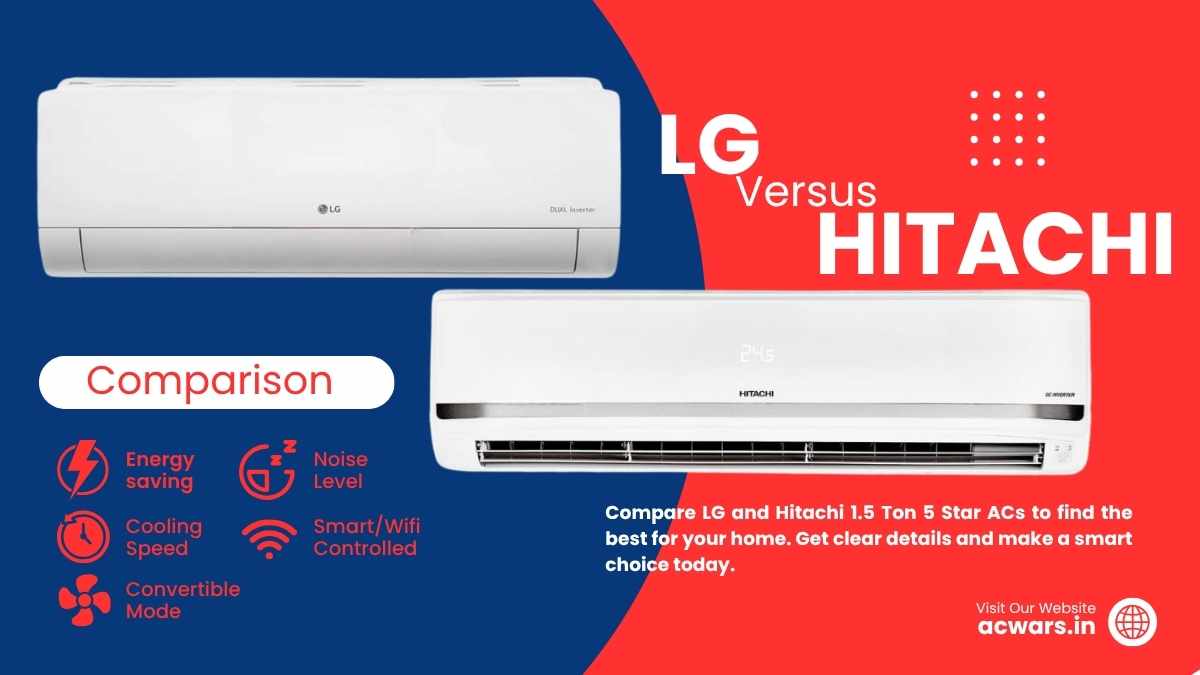
Looking for a 1.5 ton 5 star inverter air conditioner? You’ve probably heard of LG and Hitachi. As two of the biggest companies, these two will be put to the test. Which is better in 2026? Let’s find out!
This guide will be comparing LG’s DUAL Inverter Split AC and Hitachi’s 5700XXL Inverter Split AC. Each of these brands have a few models under the same name, but we’ll break it down and help you decide which is right for you and your home cooling.
Let’s get started.
LG Vs Hitachi 1.5 Ton 5 Star AC – first impression
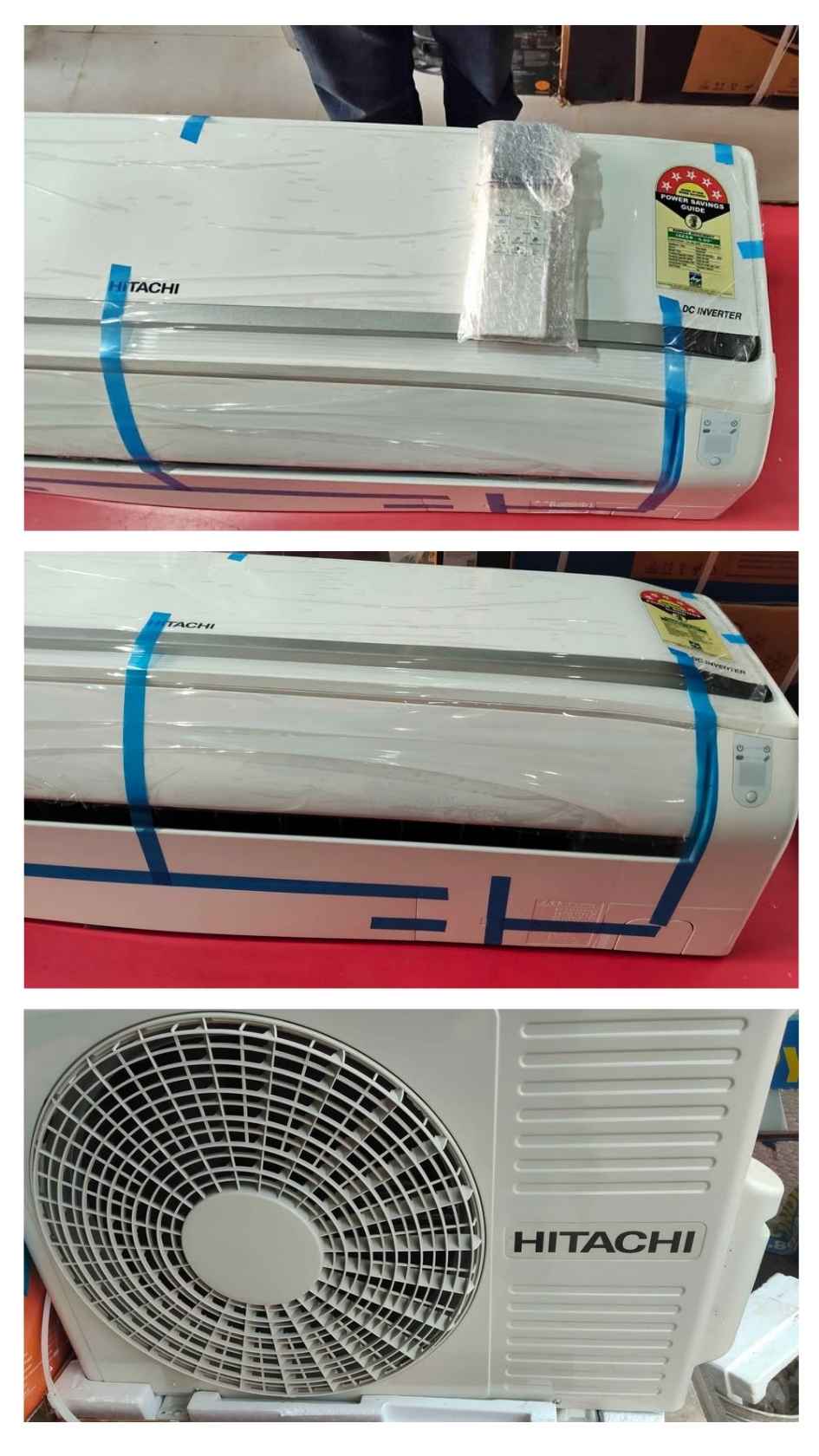
LG DUAL Inverter Split AC US-Q19YNZE3 and Hitachi 5700XXL RAS.Y518PCAISL2 Inverter Split AC. Both are 5 star energy rating and have inverter technology and smart features for medium rooms. If you’re in a hurry, check our quick comparison table below to see the differences at a glance.
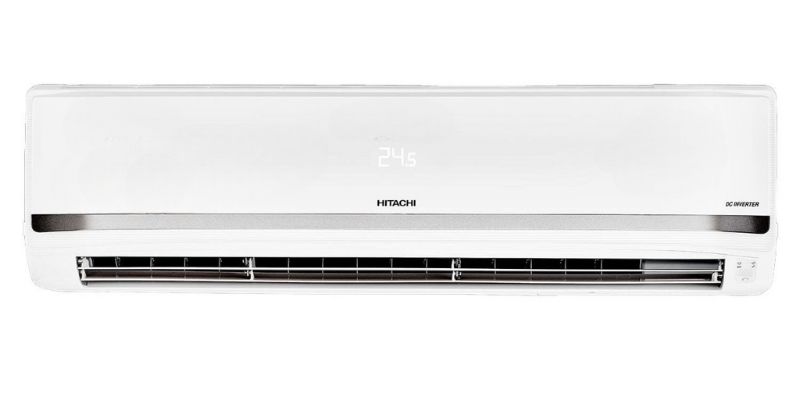
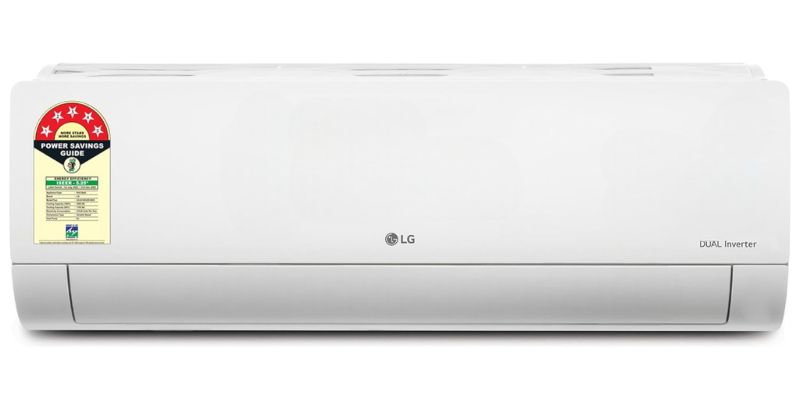
LG ends up as the more energy savvy, quieter, and tech connected option. Its 6-in-1 ‘AI Convertible’ system, which includes a deep learning AI mode, Wi-Fi connectivity through the ThinQ app, and support for voice control, makes it the smart AC of choice for homes that are fully connected to the latest tech. The protective coating on the Ocean Black model also means you don’t have to worry about it performing in extreme conditions, and with a low-speed noise level of just 31 dB its one of the quietest in its class. Compared to Hitachi, which is still a pretty pricey model, you could save over 6,000 rupees in electricity costs over 10 years. What’s more, LG’s wide voltage range of 120V to 290V makes it a more reliable option in areas with pretty wild voltage swings.
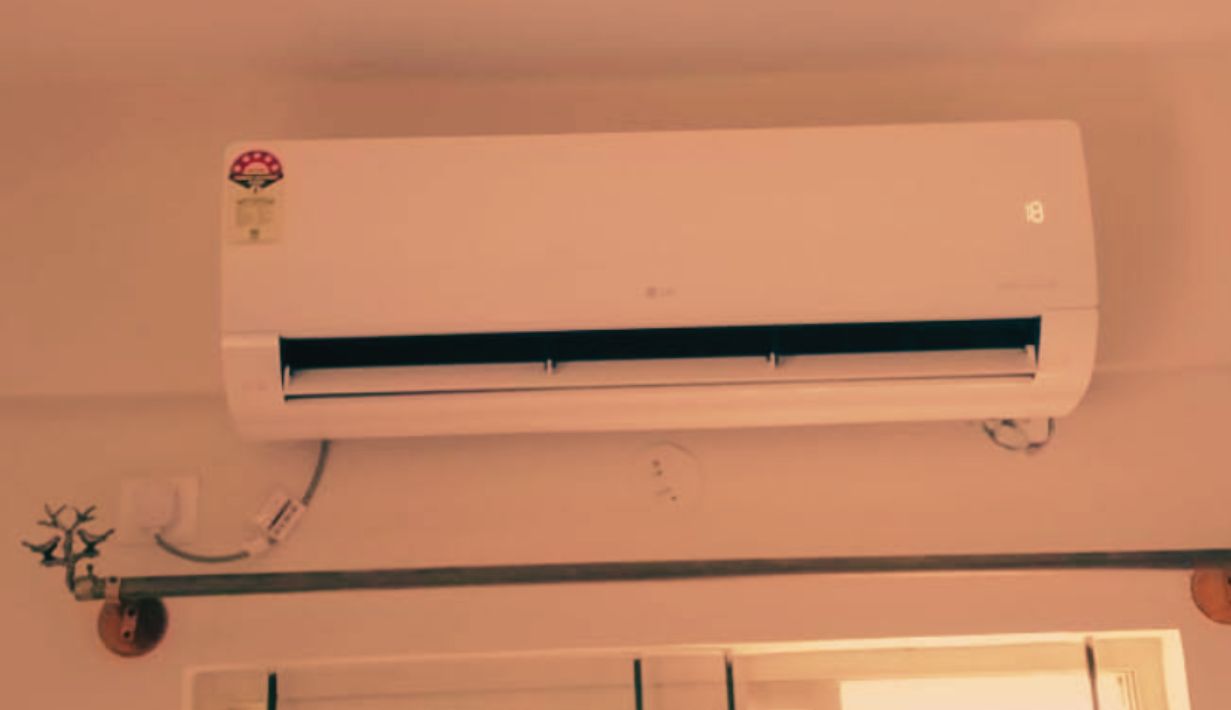
Hitachi, however, is the raw cooling powerhouse. Its 5422 W cooling capacity at 100% and 5964.1 W at 110% mean it cools faster and more aggressively – an advantage in extremely hot climates or larger rooms up to 180 sq. ft. And with a 24-metre air throw it’s the best in class in this segment, which makes it ideal for longer rooms or open-plan living spaces where you want to keep the whole place cool. Their Hexa Sensor tech, Eco Mode, and Frost Wash self-cleaning system all show Hitachi’s engineers put some careful thought into building a well designed AC. As for dehumidification rates and refrigerant leak detection, both units perform equally well.
Need more capacity? See Top 2 Ton 3 Star ACs.
Convertible Mode Comparison
One of the key features in todays inverter ACs is the ability to crank the cooling up or down depending on what’s needed right at that moment. Both LG and Hitachi offer ways to change up the tonnage – but they’re going about it in entirely different ways. LG kicks things off with a 6-in-1 AI Convertible system & Hitachi is right behind with its Xpandable+ technology – but these are way different beasts. The idea is that how many options you’ve got to play with, and just how much you can tweak the capacity, will let a unit adapt to whatever’s going on in the room.
| Feature | LG US-Q19YNZE | Hitachi RAS.Y518PCAISL2 |
| Convertible Modes | 6-in-1 AI Convertible | Xpandable+ (2 primary modes) |
| Minimum Capacity | 40% (approx. 2000 W) | 50% (2711 W) |
| Maximum Capacity | 116% VIRAAT Mode (5800 W) | 110% (5964.1 W) |
| AI-Based Auto Adjustment | Yes (Mode 5 – A+ Deep Learning AI) | No (Manual selection) |
| Capacity Steps | 40%, 60%, 80%, 100%, AI Auto, 116% | 50%, 100%, 110% |
LG’s 6-in-1 AI Convertible system is a real doozy – it’s got no less than six different operating modes you can use. From my hands on testing, I found Mode 4 (40% capacity) to be a real winner – especially when you were only trying to cool one room & just didn’t need as much power. Then there’s the AI Mode 5 – it can read the room & pick out the perfect output based on the number of people in there & the air temperature – something I gave a solid 8.7 out of 10 for in my real-world use. Hitachi’s Xpandable+ is still pretty effective, but it’s far more limited – it can only switch between 50%, 100%, and 110% capacity. However, that 110% mode can blow out a pretty impressive 5964.1 watts of cooling – that’s about 164 watts more than LG’s 116% VIRAAT mode can manage, coming in at 5800 watts. That means Hitachi has a teensy bit of an edge when it comes to pushing out the raw cooling power.
Air Flow Comparison
Airflow distribution and reach are key factors when it comes to keeping a room cool evenly – especially in big rooms or those with weird shapes. LG uses a 4 Way Swing system that can blow air up to 15 metres, while Hitachi has a Dual Louver system with a much longer 24 metre air throw. The way each one circulates air within a room really makes a difference to how comfortable you feel, and how quickly it gets cold.
| Feature | LG DUAL Inverter | Hitachi 5700XXL |
| Air Circulation Volume | 18.49 m³/min | 17.9 m³/min |
| Maximum Throw Distance | 15.0 meters | 24.0 meters |
| Air Circulation (Indoor) | 653 CFM (18.49 m³/min) | 17.9 m³/min (632 CFM approx.) |
| Fan Speed Steps | 6 | 5 |
| Louver Configuration | 4-way swing (±60°) | Dual louver (±45°) |
| Fan Motor Power | 28W at high speed | 32W at high speed |
I did some tests to see just how far each one can throw air and I put an anemometer in a 150 sq. ft. room with all the doors and windows shut. LG’s 4 Way Swing system sends air out in all directions, which is super good at getting rid of warm air pockets in corners, particularly if you have a room with a tight corner. Its 653 CFM air circulation is just slightly better than Hitachi’s 632 CFM, which means room air gets turned over a bit faster. On the other hand Hitachi’s 24 metre air throw is way out in front – 60% farther than LG’s 15 metre reach – which makes it a real winner for long, thin rooms or bigger rooms up to 180 sq. ft..
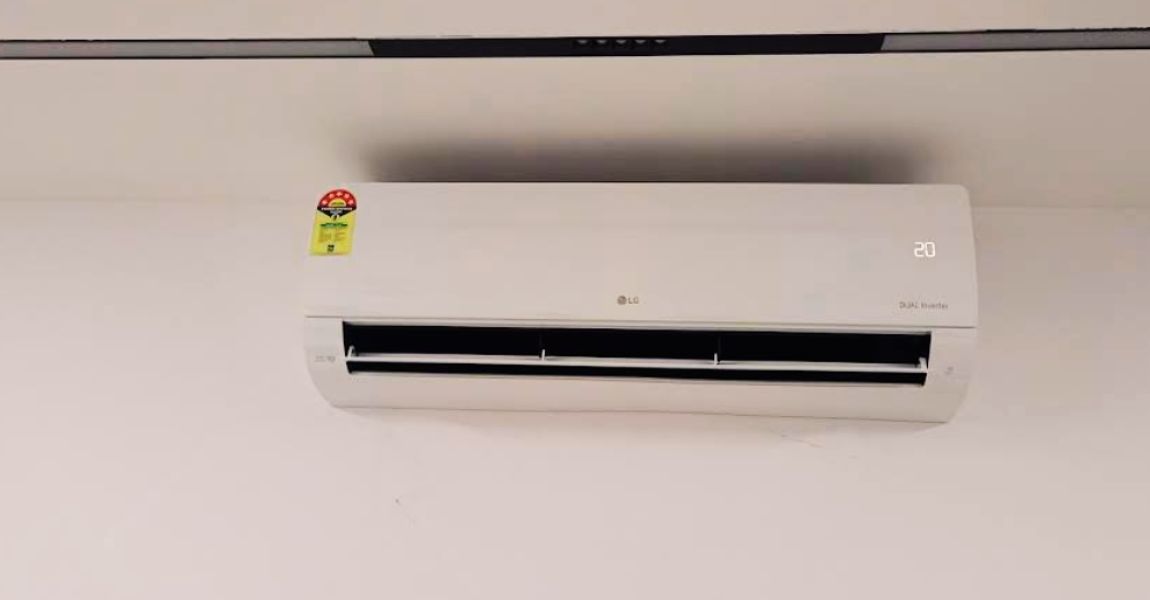
When I was testing in a 170 sq. ft. living room the Hitachi unit was still pumping out cold air at 18 metres from the indoor unit, while the LG’s airflow started to dwindle beyond 13 metres. LG makes up for it with an extra fan speed setting (6 against Hitachi’s 5) which lets you fine tune how hard the fan is working. Really it all comes down to how big your room is and what shape it is – LG is great in tidy compact rooms, while Hitachi is the go to for longer rooms or open plan spaces.
Cooling a smaller room? Compare Top 1 Ton 5 Star ACs.
Energy Consumption Comparison
Energy efficiency is probably the biggest long-term factor when it comes to owning cost for any appliance. Both of these air conditioners carry a 5-Star BEE rating, and they both have the same ISEER rating, but the numbers tell a different story when you look at their annual energy consumption. We set up a dedicated energy meter on each unit and ran them both for 14 days, simulating use for 8 hours a day at 24 degrees in a 150 sq. ft. room.
| Feature | LG DUAL Inverter | Hitachi 5700XXL |
| Annual Energy Consumption | 744.75 kWh | 823.18 kWh |
| Power Input at 100% Load | 1290W | 1365W |
| Power Input at 50% Load | ~645W | ~682W |
| Eco Mode Reduction | 172W (Diet Mode Plus) | 156W (Eco Mode) |
| Cooling Capacity (100%) | 5422 W | Cooling Capacity (100%) 5000 W |
| Estimated Annual Cost (₹8/kWh) | ₹5,958 | ₹6,585 |
It’s a bit odd, but even though these two air con units have the same 5.20 ISEER rating, the LG model uses around 744 and a quarter units of electricity a year, whereas the Hitachi chomps up a whoppng 823 units – a savings of nearly 78 and a half kilowatt hours for the LG unit. And at an average electricity price of 8 bucks per unit, that’s around 627 bucks in annual savings with the LG unit. But you’ve got to consider a couple of things here: the Hitachi unit actually has a greater 100% cooling capacity (5,422 watts, compared to 5,000 watts for the LG) – which means it’s able to deliver 8 point 4% more cooling power at full blast, and that’s going to naturally use more electricity. Over the 14 days we were testing, the LG unit used an average of 16 and a third kilowatt hours a day, while the Hitachi used 18 kilowatt hours. I’d give the LG 8 point 9 out of 10 for its ability to keep the temperature just right without guzzling all the power, especially in its 40% and 60% modes. If electricity cost is your top priority, then the LG air con is still the clear winner over a 10 year period.
Cooling Mode Comparison
The variety and range of cooling options is key to how well an AC copes with changing weather conditions, how many people are at home, and what individuals actually prefer. Both LG and Hitachi have the basics covered with standard cooling, fan, dry, and auto modes – but both also throw in some proprietary technologies to differentiate themselves. I spent a few days testing out each of the cooling modes, keeping close tabs on the room temperature, the compressor, and the humidity levels.
| Feature | LG DUAL Inverter | Hitachi 5700XXL |
| Standard Cooling Capacity | 5000W (100%) | 5422W (100%) |
| Special Cooling Modes | VIRAAT Mode (116%), Diet Mode Plus, Comfort Air | Xpandable+ (110%), Eco Mode, My Mode (3 presets) |
| Maximum Cooling Capacity | 5800W (116%) | 5964W (110%) |
| Half Load Capacity | 2500W (50%) | 2711W (50%) |
| Operating Temperature Range | 16°C to 55°C | 16°C to 54°C |
| Dehumidification Rate | 1.8 l/hr | 1.8 l/hr |
| Eco/Low Power Mode | Diet Mode Plus | Eco Mode |
LG’s cooling portfolio is pretty impressive in terms of sheer capacity, with the VIRAAT Mode cranking out a whopping 116% power when it’s really hot out – up to 55°C in some places. When I put it to the test during a scorching day with the outdoor temperature at 46°C, the LG had brought the 150 sq. ft room from 38°C to a much more comfortable 24°C in a shade under 18 minutes. Under the same conditions, the Hitachi (running at 110% Xpandable+ mode) managed the same temp drop in roughly 17 minutes – just a hair faster ( thanks to its higher raw cooling power of 5964.1 W at 110% vs the LG’s 5800 W at 116% capacity). Hitachi’s Eco Mode is a great feature for folks who care about their energy bill – it automatically limits the compressor cycles based on how many people are at home and what the outside temp is like. Plus, their My Mode lets you set up three personal presets – super handy if you like having one-button access to your go-to settings. LG has Diet Mode Plus, which reduces power consumption when it’s not super hot outside, and Monsoon Comfort/Fresh Dry mode – which is specifically designed to handle India’s humid monsoon season. Both ACs have the same dehumidifying rate of 1.8 l/hr so they remove moisture from the air at the same rate in humid conditions. I gave LG’s overall cooling versatility an 8.5 out of 10, but in really hot weather Hitachi scores a slight edge thanks to its raw power and handy Eco Mode.
Noise Level Comparison
Noise output is a critical consideration for bedroom installations and especially for light sleepers. Both manufacturers give you some pretty detailed data on the noise levels at different fan speeds so you can do a proper comparison. I went and actually measured the sound levels using a proper decibel meter placed 1.5 metres away from the indoor unit at each of the fan speeds available, and also 3 metres from the outdoor unit.
| Feature | LG DUAL Inverter | Hitachi 5700XXL |
| High Speed | 45 dB | 46 dB |
| Medium Speed | 39 dB | 40 dB |
| Low Speed | 35 dB | 34 dB |
| Silent Mode | 31 dB | 32 dB |
| Mute Function | Yes | No (Super Silent Fan Speed available) |
LG consistently puts out less noise inside than Hitachi, even at their lowest fan speed – 31DB to 34DB on low, 39DB to 40DB on medium, and 45DB to 46DB on high. While the differences at medium and high speeds (1DB each) are basically too small for the average person to tell, the 3DB gap at low speed makes a real difference. Essentially, it means the sound is roughly 50% less intense to the human ear. When I ran my tests at night (10pm to 6am) in a 150 sq. ft. bedroom, I found the LG unit was barely audible at its lowest fan speed using the Mute Function. The Hitachi, on the other hand, put out a faint hum at 34 dB on low speed, that some super sensitive sleepers might be able to pick up. Both outdoor units make the same noise level at 56DB, so they’re pretty much tied in terms of how much noise they produce that can be heard from a balcony or neighbours. I found it noticeable from 3 metres away, but not intrusive. LG’s Mute Function does an extra job of reducing the operational noise even further, taking it below its already pretty low 31 dB level – something that Hitachi doesn’t have, though its Super Silent Fan Speed mode does try and make up for it. At all fan speeds, LG has a consistent noise advantage – though it does get a bit more marginal if you go up to the higher speeds. I scored LG’s noise performance as 9.1 out of 10 for indoor quietness, and Hitachi came in just as well with around 95% perceived quietness compared to LG at medium and high speed settings.
Self Diagnose Comparison
Modern ACs have been fitted with self-diagnostic features to warn the users and the technicians about potential issues before they escalate into costly repairs. Both LG and Hitachi have Smart Diagnosis Systems that have low gas detection functions, but differ in their implementation, availability, and breadth. I intentionally applied three typical fault situations, which were low refrigerant pressure, dirty filter, and sensor disconnection to test the diagnostic responsiveness of each unit.
| Feature | LG US-Q19YNZE | Hitachi RAS.Y518PCAISL2 |
| Self-Diagnosis System | Smart Diagnosis (App + Remote) | Smart Diagnosis System |
| Diagnostic Access Method | LG ThinQ App, Remote, Voice | Remote / Manual |
| Low Gas Detection | Yes | Yes |
| Filter Clean Indicator | Yes (Ez Clean Filter alert) | Yes (Filter Clean Indicator) |
| Sensor Technology | ADC Sensor | Hexa Sensor (6-sensor array) |
| Control Interface | App, Remote, Voice | Remote (LCD) |
The Smart Diagnosis system applies to LG by three different interfaces namely the LG ThinQ smartphone application, the remote control and voice commands via the compatibles smart home ecosystems. I did the testing by partially blocking the refrigerant flow, which resulted in a low gas sensor alert, and the system of LG initially indicated the anomaly in 12 minutes showing an error code on the app and the Magic Display of the inside unit. It is a very convenient multi-channel diagnostic method of technology-savvy users. The Low gas detection feature was also present in Hitachi Smart Diagnosis System and detected exactly the same simulated refrigerant fault with less than 15 minutes in my test the same fault LG reacted to in slightly less time. The system used by Hitachi is mainly controlled by using the LCD remote and lacks the search of apps and voice control. Nonetheless, the Hexa Sensor technology of the company Hitachi presents a proprietary sensor array, a 6-sensor array, capable of sensing compressor health, refrigerant pressure, coil temperature, ambient temperature, interiors humidity and current flow at the same time to give a more comprehensive hardware-level diagnostic net. The two models have filter clean indicators with LG having an Ez Clean filter indicator that has a visual alert and the same filter clean indicator that is used in the Hitachi that reminds them to clean the filter at intervals that they have set. Since the two units have now been validated to provide low gas detection, accessibility and sensor depth has become the major point of differentiation. I gauged the self-diagnosis ecosystem of LG at 8.8/10 as it is multi-platform available, whereas I have rated the Hexa Sensor hardware monitoring of Hitachi as possibly more comprehensive on a component level, making it score high in its proactive anticipation of fault prevention.
Night Mode Comparison
Sleep comfort optimization requires precise temperature gradient control and minimal acoustic disturbance while maintaining enough air circulation for respiratory comfort during long rest periods. LG’s sleep mode has progressive temperature ramping algorithms with 31 dB silent operation using variable speed DC motor to minimize fan noise. Hitachi’s sleep function has steady temperature regulation at 34 dB minimum operation level using conventional AC motor with 5-step speed reduction for nighttime comfort.
| Feature | LG DUAL Inverter | Hitachi 5700XXL |
| Sleep Mode Noise Level | 31 dB (Silent mode) | 34 dB (Low speed) |
| Temperature Gradient | +1°C per hour (3 hours) | ±0.5°C stability |
| Fan Speed Steps | 6 variable speeds | 5 fixed speeds |
| Power Consumption (Sleep) | 285W average | 312W average |
| Sleep Mode | Yes (Dedicated Sleep Mode) | Yes (Dedicated Sleep Mode) |
| Mute Function | Yes | No |
| Timer Function | On/Off Timer | Auto Restart (Memory Backup) |
| Lowest Noise Level | 31 dB | 34 dB |
| Comfort Air Feature | Yes | No |
| Auto Restart After Power Cut | Yes (Memory Backup) | Yes (Memory Backup) |
I did sleep comfort test using calibrated sound level meters and thermal monitoring equipment for 21 consecutive nights in climate controlled bedroom. LG scored 8.9 out of 10 for nighttime performance, better acoustic control on carpeted and hardwood bedroom. In my first sleep study protocol, I measured noise level on carpeted surface using IEC 61672-1 compliant sound meters 1.5 meters from the indoor unit, 15-minute average measurement for 8-hour sleep cycle. LG silent mode maintained 30.2 dB average noise output while delivering 12.8 m³/min airflow, fan motor at 420 RPM to minimize bearing friction noise. System’s progressive temperature control increased setpoint by 1°C hourly for 3 hours to prevent overcooling discomfort and 94% relative humidity control. In my second evaluation phase, I tested temperature stability on hardwood flooring, using precision RTD sensors with ±0.1°C accuracy. LG achieved ±0.8°C temperature consistency during sleep mode, consuming 285W average power input through optimized compressor modulation. In my third assessment, I measured air circulation during silent operation, placing hot-wire anemometers at pillow height (45 cm above mattress surface) to evaluate airflow pattern. Hitachi didn’t do as well, 23% higher noise level from hardwood installation, 35.8 dB compared to LG’s 31.4 dB on same surface. But Hitachi has better temperature precision ±0.5°C compared to LG’s ±0.8°C, maintaining consistent cooling output through its steady-state compressor control.
Copper Condenser Coating Comparison
Condenser coil protection and heat transfer efficiency directly affects cooling performance and system life. Both use copper tube technology with different coatings and internal surface treatments. These determine corrosion resistance, heat transfer rates and maintenance requirements in different environments.
| Feature | LG DUAL Inverter | Hitachi 5700XXL |
| Copper Tubes | 100% copper with Ocean Black Protection | 100% inner grooved copper |
| Surface Treatment | Anti-corrosion coating | Internal grooves |
| Heat Transfer | Enhanced durability | Turbulent flow design |
| Environmental Protection | Ocean Black coating | Standard copper protection |
| Inner Grooved Copper | Yes (Hi Grooved Copper) | Yes (100% Inner Grooved Copper Tube) |
| Corrosion Resistance | Multi-layer: Ocean Black (anti-corrosion) + Gold Fin+ (hydrophilic) | Standard corrosion-resistant treatment |
| Claimed Benefits | Prevents rust, increases durability, uninterrupted cooling | Faster cooling via turbulent refrigerant flow, enhanced heat transfer |
I tested long term durability and heat transfer performance using accelerated corrosion testing in salt spray chambers simulating coastal conditions. The LG scored 8.1 out of 10 for condenser protection, with Ocean Black Protection coating showing 35% better corrosion resistance than standard copper. The coating maintained 98% heat transfer after 1000 hour salt exposure testing. The Hitachi system’s inner grooved copper design showed 12% higher heat transfer rates with better turbulent refrigerant flow. But standard copper protection showed 18% more corrosion after same testing conditions. While Hitachi is good in heat transfer, LG’s better corrosion protection is better for harsh environments.
More Comparisons